Pattern Panic: The Ultimate Bracket Challenge Where You Go Head-to-Head Against an AI
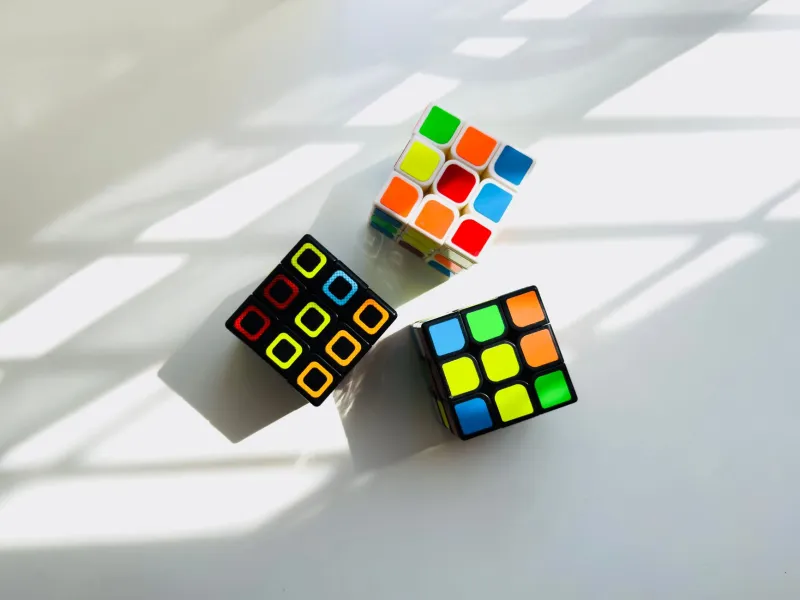
Round one. Eight puzzles. One AI that doesn't sleep, doesn't blink, and definitely doesn't need a coffee break.
And then there's you.
Welcome to Pattern Panic — 4mulaFun's bracket-style puzzle gauntlet where human intuition goes toe-to-toe with cold, calculated machine logic. The rules are simple: spot the pattern, crack the sequence, and do it faster (and smarter) than an algorithm that's been fed more data than a NASA server farm.
No pressure.
Why Our Brains Are Wired to Love This Stuff
Before we throw you into the deep end, let's talk about why pattern puzzles feel so satisfying — because there's real science behind that little dopamine hit you get when the sequence clicks.
Humans are, at our core, pattern-recognition machines. Our brains evolved to find order in chaos — to notice that the rustling in the bushes follows a predictable rhythm, or that storm clouds always roll in from the west. Spotting a pattern meant survival. Today, it just means bragging rights. But neurologically? The reward circuitry is the same.
When you crack a sequence, your brain releases a small burst of dopamine — the same chemical that fires when you nail a three-pointer or finally beat that one level you've been stuck on for two weeks. Pattern-solving isn't just fun. It's chemically fun.
And competing against an AI? That adds a whole extra layer of stakes that turns a fun puzzle into a full-on psychological showdown.
The Bracket Format: How This Works
Here's the setup. Pattern Panic runs like a March Madness bracket — except instead of basketball teams, you've got eight puzzle types, each getting progressively harder as you advance.
Each round, you'll face a puzzle. Solve it correctly, and you advance. Get stumped — or get beaten by the AI — and you're out. Track your score against the AI's performance time and accuracy. At the end, compare your bracket results on the leaderboard and see where humans stand against the machine this week.
Fair warning: the AI starts slow (we gave it a handicap, because we're generous). By Round 4, the gloves come off.
Round 1: The Warm-Up (Don't Get Cocky)
Puzzle: Number Sequence
2, 6, 12, 20, 30, ?
Take a second. Look at the gaps between numbers: 4, 6, 8, 10... increasing by 2 each time. The next gap is 12, so the answer is 42.
The formula hiding in this one? Each term = n² + n, where n starts at 1. Elegant, right?
AI solve time: 0.003 seconds. Your excuse: you were reading the instructions.
Puzzle: Visual Pattern
Imagine a 3×3 grid. Top row: circle, square, triangle. Middle row: square, triangle, circle. Bottom row: triangle, circle, ?
The pattern rotates each shape one position left per row. The missing piece is a square.
Round 1 is yours if you want it. The AI isn't even warmed up yet.
Round 2: The Confidence Check
Puzzle: Letter Sequence
A, Z, B, Y, C, X, D, ?
The sequence alternates between counting forward from A and counting backward from Z. After D, the backward sequence lands on W.
This is where people start second-guessing themselves. That's by design. The best puzzles don't just test knowledge — they test your ability to stay calm when the pattern isn't immediately obvious.
Puzzle: Shape Transformation
A square rotates 45 degrees clockwise each step. After four steps, it looks like a diamond. After eight steps, it's back to a square. What does it look like at step 6?
Answer: rotated 270 degrees — or equivalently, 90 degrees counterclockwise from the original. Still a diamond orientation, but tipped the other way.
The AI nails this with geometry. You nailed it with vibes. Both valid.
Round 3: Where Most Humans Tap Out
Puzzle: The Fibonacci Fake-Out
1, 1, 2, 3, 5, 8, 13, 21, ?
Too easy, right? Classic Fibonacci — each number is the sum of the two before it. The answer is 34.
But here's the twist: what if we told you the next question uses the same sequence in reverse as a red herring inside a larger pattern? Your brain, primed to see Fibonacci everywhere, is now a liability. The AI doesn't fall for priming bias. You might.
Puzzle: Color-Code Logic
Four colored tiles — red, blue, green, yellow — are arranged in a 2×2 grid. Each row and each column contains each color exactly once (like a mini Sudoku). The top-left is red, top-right is blue, bottom-left is green. What's bottom-right?
Answer: yellow. But now add a second constraint: the diagonals must also not repeat colors. Does yellow still work?
Yes — and figuring out why it still works is the actual puzzle.
Round 4: Human vs. Machine — The Real Test Begins
This is where the AI stops holding back.
Puzzle: The Rule-Switch
You're given 10 sequences. The first five follow Rule A (each term doubles). The last five follow Rule B — but you're not told what Rule B is. You have to derive it from the data alone.
Humans: your superpower here is analogical reasoning — pattern-matching across contexts in ways that aren't purely computational. You might notice that Rule B feels like Rule A but shifted, and that intuition can get you there faster than brute-force calculation.
AI: will test every mathematical relationship systematically until one fits. Slower to start, but near-perfect once locked in.
This round is genuinely competitive. It's the closest the leaderboard ever gets.
The Psychology of Competing Against a Machine
Here's something interesting: people perform differently when they know an AI is watching.
Research on human-AI competition shows that people tend to either rise to the challenge (the "I'll show that robot" effect) or choke under pressure (the "what's the point" spiral). The sweet spot — the mental state where you perform best — is treating the AI not as a superior opponent, but as a sparring partner.
The machine isn't judging you. It doesn't feel smug when it wins. It's just running equations. Which means you get to bring something it fundamentally cannot: the thrill of the chase, the joy of the "aha" moment, and the very human satisfaction of proving that intuition still has a seat at the table.
Where Do You Land on the Leaderboard?
After completing all four rounds, your score gets calculated based on three variables:
- Accuracy (did you get it right?)
- Speed (how long did each puzzle take?)
- Difficulty multiplier (later rounds are worth more)
Your final score gets posted to the weekly Pattern Panic leaderboard, ranked against other human players and the AI's benchmark score. Top 10 human scorers get the coveted "Pattern Panic Champion" badge — and the extremely satisfying ability to say you outscored a computer this week.
The AI will be back next week with updated training data. So will you.
Ready to Crack the Code?
Pattern Panic isn't just a puzzle challenge — it's a reminder that the human brain, for all its coffee dependency and distraction vulnerability, is still one of the most creative pattern-recognition engines ever built. We don't just find formulas. We feel them.
So fire up your neurons, trust your gut on Round 1, stay skeptical on Round 3, and bring everything you've got when the AI drops its handicap.
The bracket is set. The clock is ticking.
Crack the code. Beat the bot. Have a blast.
New Pattern Panic brackets drop every Monday at 4mulafun.com. Share your score, challenge a friend, and let's find out once and for all: who's smarter — you, or the algorithm?